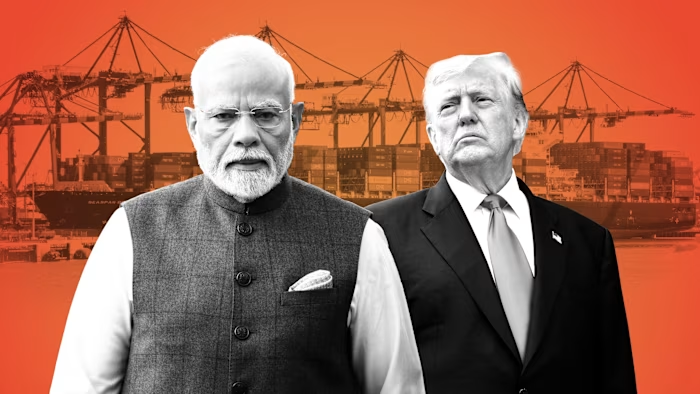
New Delhi | In any democratic nation, strategic autonomy is not merely a technical term of foreign policy but a fundamental question of sovereignty and self-respect. A country’s true strength is not measured by military budgets, global speeches, or high-profile photographs with foreign leaders, but by its ability to take independent decisions aligned with its national interests. In this context, the debate around whether India is genuinely making its own decisions has become increasingly significant.
India today projects itself as a strong nation, an emerging global power, and a potential “Vishwaguru.” However, the core question remains whether the country is shaping its policies independently or calibrating its decisions in response to external pressures from major global powers. Foreign policy, more than any other domain, reflects a nation’s sovereignty. It determines who a country partners with, where it draws boundaries, and on what terms it engages with the global order.
Historically, India followed a path of non-alignment and later strategic autonomy, maintaining relationships with multiple power blocs without becoming a permanent ally of any one. During the Cold War, India balanced ties with both the United States and the Soviet Union, inspiring many newly independent nations in Asia and Africa. In the present geopolitical climate—marked by US-China rivalry and the fallout of the Russia-Ukraine conflict—this balance faces unprecedented pressure.
The case of Iran’s Chabahar Port highlights this challenge. For India, Chabahar was not merely a commercial project but a strategic gateway to Afghanistan, Central Asia, and West Asia, bypassing Pakistan and counterbalancing China’s influence in the region. Following renewed US sanctions and the withdrawal of exemptions, India’s long-term commitment to the project has weakened, raising questions about whether strategic considerations were overridden by fear of diplomatic fallout.
Similarly, India’s decision to import discounted crude oil from Russia has been driven by energy security and economic pragmatism. Despite Western sanctions, India initially asserted its right to choose energy sources based on national interest. Over time, however, diplomatic pressure and indirect signals from Western nations have influenced corporate and policy-level adjustments. While Russian oil imports remain significant, the episode underscores how global narratives can challenge independent decision-making.

Observers caution against equating international praise, headlines, and symbolic gestures with genuine national strength. Global applause is fleeting, while decisions taken in favor of long-term national interest define a country’s enduring stature. History offers examples where external support shifted rapidly, leaving nations vulnerable when strategic autonomy was compromised.
In a democracy, questioning foreign policy and security decisions should not be seen as disloyalty. Constructive criticism and debate are essential to ensuring that national interests remain paramount. Patriotism, many argue, lies not in unquestioning agreement but in the courage to speak truth in the interest of the nation.
The true test of “Atmanirbhar Bharat” goes beyond domestic manufacturing figures. It lies in India’s ability to independently shape its foreign policy, energy choices, and strategic partnerships. As India stands at a geopolitical crossroads, the path it chooses will determine whether it emerges as a truly sovereign and confident global power or evolves into a strategically influential yet dependent partner. The coming years will reveal whether India prioritizes global approval—or firmly safeguards its independent stance on the world stage.